



Welcome to The Bias Codex, a series about the ways our brains perceive, interpret, and sometimes misread the world around us. Each article explores a few cognitive biases through games, looking at how they shape the player experience and how understanding them can help us design better ones.
For this first article, we will start with a pair of biases that influence different parts of the user journey, but both lead back to the same question: what happens when the player’s mind meets the system we’ve built?
Every game exists in two forms, the one we designed and the one the player is actually able to understand the moment they start playing.
Well, that second version is the one that matters, so we better pay attention.
But before we dive in, let’s quickly establish what exactly a cognitive bias is.
🔎 What is a Cognitive Bias?
A cognitive bias is basically a shortcut our brain uses to process information faster. Most of the time, that is helpful. We cannot carefully analyse every little detail or choice in front of us, so our brain fills in the gaps using memory, habits, expectations, emotions, and context.
The problem is that these shortcuts are not always accurate. They can make us miss something important, overvalue certain things, avoid a choice that feels risky, or assume something is right when it is not. The more we understand these mental shortcuts, the better we can design around how players actually think, react, and make sense of the experience.
With that in mind, let’s start with one of the easiest biases to fall into when designing.
1. Curse of Knowledge
The Curse of Knowledge happens when we know something so well that it becomes difficult to imagine what it feels like not to know it.
You see this in everyday life all the time. Someone gives you directions and says, “Just turn after the old bakery”, assuming you know the bakery, the street, and probably the old stories connected to that corner. The instruction makes perfect sense to them because they already have the map in their head. To you, it is just a mysterious bakery-based navigation system.
In games, the same thing can happen. After years working on the same project, the inputs are obvious, the menus feel logical, and the progression makes perfect sense. But players do not arrive with all that context. They arrive with a screen, a controller, and whatever the game manages to communicate in that moment.

A good example is Destiny 2, a live-service game with several major expansions and recurring seasonal events. For experienced players, it has years of shared language, systems, activities, characters, and rituals layered on top of each other. For a new or returning player, that same richness can feel like walking into season six of a TV show while everyone keeps referencing episodes you never watched. The game may be full of interesting things to do, but if the player does not understand what matters, where to go, or why anything is important, depth quickly turns into noise and that inviting richness becomes a burden.
That is the Curse of Knowledge in practice. The issue is not depth itself, but the moment where depth is presented as if the player already speaks the game’s language. A system can be complex, layered, and satisfying to master, but the first step into it still needs to feel readable.
For designers, this bias is a reminder to be careful with the word “obvious.” Obvious to whom? To the team that built the system, or to the player meeting it for the first time? That is why playtesting is so valuable, not just to check if players succeed, but to understand what they believe is happening while they play.
A few questions worth asking:
Are you asking the player to understand something before they have a reason to care about it?
Can a new player explain what just happened in their own words, or are they just pressing buttons automatically?
Are your icons, tutorials, and menus clear to someone outside the team, or only to the people who already know what they mean?
2. Loss Aversion
Loss aversion is the idea that losing something usually hits harder than gaining something of similar value.
You can see this outside games very easily. Finding ten euros in an old jacket is great. Losing ten euros from your wallet feels strangely personal, like the universe decided to charge you a small fee for existing. The amount is the same, but the emotional response is very different.
Games use this feeling all the time because players are constantly gaining and losing things. Once something feels earned or almost earned, losing it becomes more than a number going down, it’s a crack in the relationship between the player and the game.
A strong example is Dark Souls. When players die, they drop their souls, but they are not gone immediately. They stay where the player fell, giving them a chance to recover them. If the player dies again before reaching that spot, the loss becomes permanent.
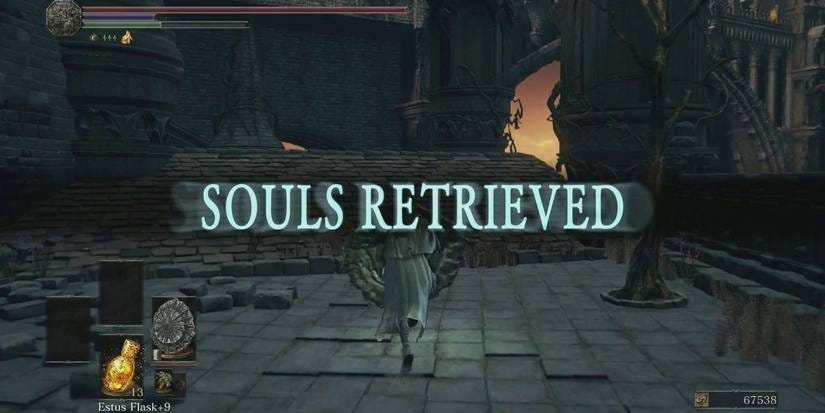
That simple rule changes the emotional meaning of the world. The player is not just replaying an area after failing. They are going back to recover something that already felt like theirs. A corridor that was dangerous before now carries more pressure, and a little bit of resentment toward the enemy that caused all of this in the first place.
This is a healthy use of loss aversion because the loss is clear, consistent, and connected to the player’s actions. The game is harsh, but the player understands what happened, what is at risk, and what they need to do next. The tension comes from the system, not from confusion.
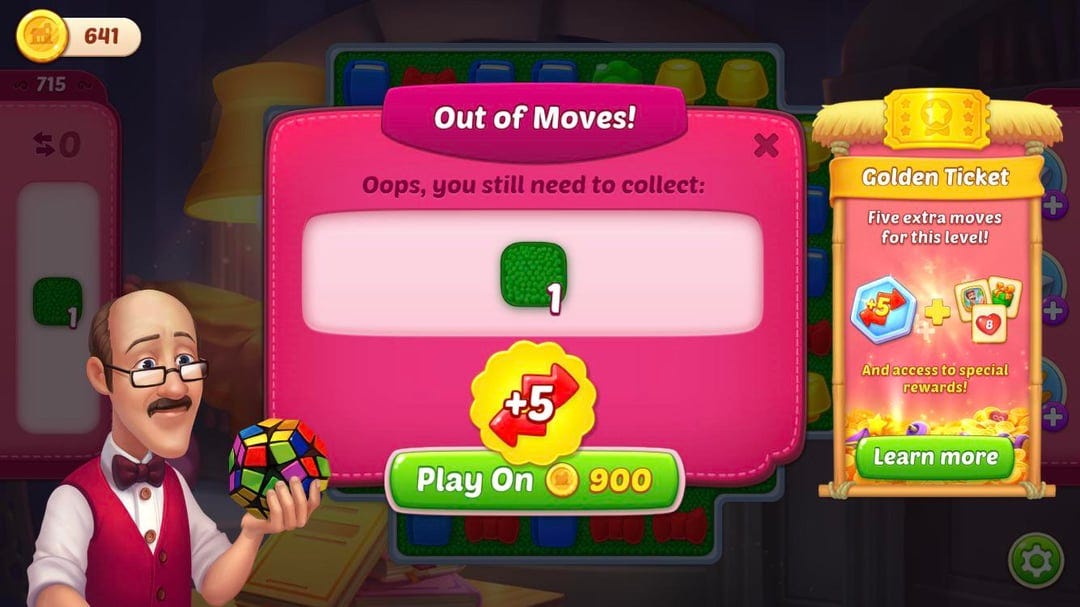
You can see a more aggressive version of this bias in many match-3 games, like Homescapes. When a player runs out of moves just one or two matches away from completing a level, the game often offers a way to continue by spending coins. On paper, this is just an option. In practice, the player is looking at a board that feels almost solved, after already investing time, effort, and maybe a few boosters.
That near-win state is where loss aversion becomes powerful. The player is not only thinking, “Do I want extra moves?” They are thinking, “Do I really want to lose this attempt now?”. This is where the line can blur between useful friction and dark pattern territory. A hard level can be satisfying, and a paid continue can be convenient, but when the game repeatedly puts you at the edge of success and offers currency as the way out, the experience starts leaning more on pressure than on challenge.
For designers, loss aversion is useful because it can create stakes, tension, and meaningful decisions. But the stronger the consequence, the clearer and fairer the communication needs to be. A good loss can make a game more memorable, and the eventual win ten times better. A bad loss can make the player stop trusting the game.
A few questions worth asking:
Does the player understand what they are risking before the loss happens?
Is the loss connected to the player’s choices, or to unclear feedback, hidden rules, or confusing UI?
Is the system creating meaningful tension, or is it mainly making the player afraid to lose time, progress, or currency?
🧩 Final Notes
Both biases expose the distance between what we intended and what the player actually experiences. With the Curse of Knowledge, that gap appears when we assume players understand more than they do. With loss aversion, it appears when we underestimate how strongly players react to losing something they already felt connected to.
That does not mean games should avoid complexity, friction, or loss. Some of the best games are built around those things. The point is to make sure the complexity is readable, the friction is intentional, and the loss feels like part of the experience rather than a consequence of confusion.
And if every game exists in two forms, the one we designed and the one the player perceives, then our job is to bring those two versions as close together as possible.
That’s all for today. See you in the next round with a new batch of biases ready to be explored! 😉
Wanna Learn More?
Here are some fantastic resources for you:
Cognitive Bias Index — A useful interactive reference to explore different cognitive biases, what they mean, and how they can affect us.
Thinking, Fast and Slow by Daniel Kahneman — A great foundation for understanding why biases matter beyond games.
Cognitive Psychology Applied to User Experience in Video Games by Celia Hodent — A great starting point for connecting psychology and UX in games.
DarkPattern.games — A useful reference for spotting when design patterns start crossing the line from motivation into manipulation.